Why Psiphon?
Psiphon was built to give you open access, even on networks designed to keep you out. Browse, stream, call, play, and connect with an app that automatically tries multiple ways to reach the open internet.
SECTION 1
How blocking works
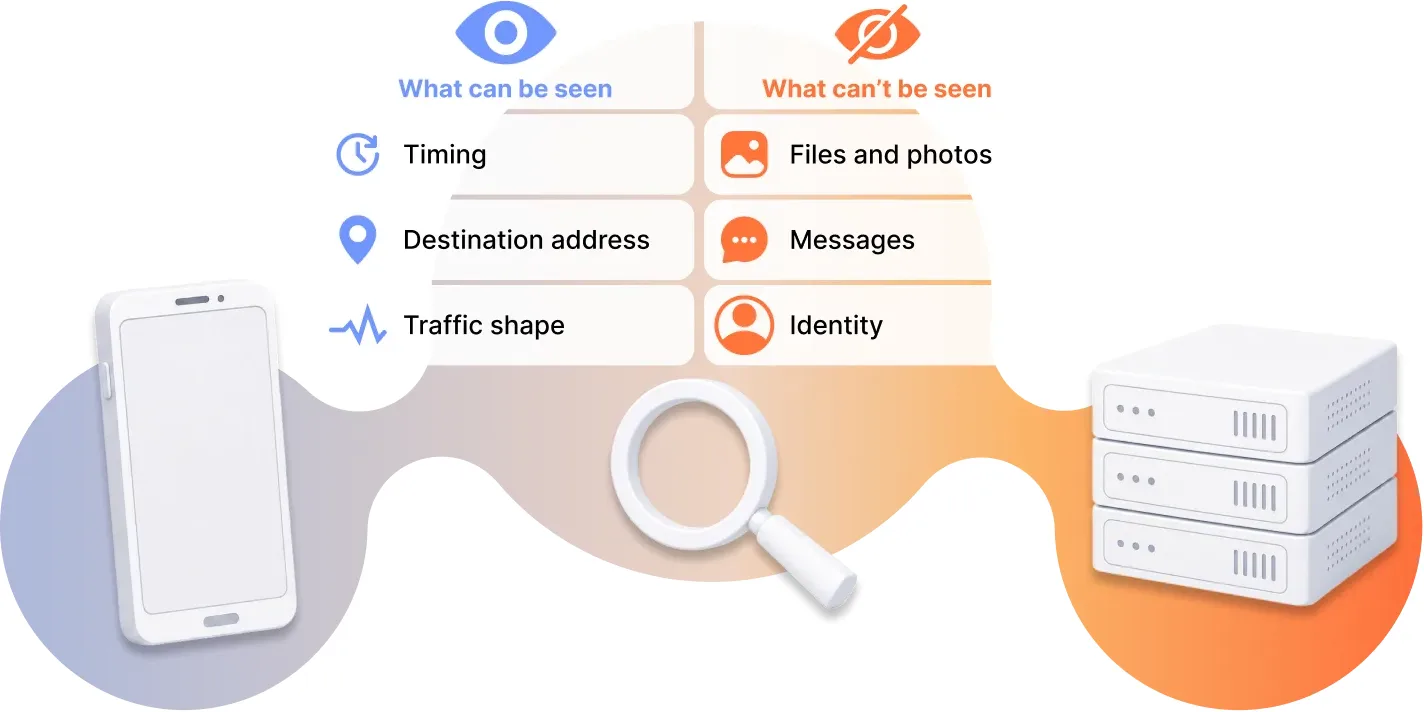
For a network operator, blocking access to a website or service can be technically straightforward. A network operator sits between you and the rest of the internet, so it can decide what gets through. Requests for particular domains can be redirected, given a false response, or simply ignored. Traffic to particular addresses can be dropped. And increasingly, traffic can be blocked simply because it looks like VPN traffic, based on its shape and behaviour, without anyone needing to know what is inside it.
That is why encryption alone is not enough. Your traffic can be completely unreadable and still be easy to recognize and block. It is also where conventional VPNs are vulnerable: they typically rely on a small number of protocols and a known set of servers. A protocol can develop a recognizable signature. Server addresses can be discovered and blocked. A VPN may work on an open network but fail when the network actively blocks VPN traffic. Psiphon is designed for exactly those conditions.
SECTION 2
How Psiphon connects
The horserace
When Psiphon connects, it does not choose a single method and hope. It starts several different connection attempts at once, running direct protocols alongside obfuscated ones to find out which actually gets through and which does it fastest, then uses the winner. There is more going on underneath than that description suggests: each attempt carries its own configuration, and the app is weighing results continuously against the conditions on the network you are on right now, which are not the conditions it faced an hour ago.
We call this the horserace, and it runs every time you connect. On an open network it usually finishes so fast you will not notice it happened. On a filtered one it is the difference between connecting and not. If the winning method stops working partway through your session, Psiphon does not wait for you to notice. It runs the race again and moves you across.

Harder to Recognize
Having several ways to connect gives Psiphon alternatives when one is blocked. Psiphon also obscures the identifying features of its connections, making its traffic harder to distinguish from other encrypted internet activity. This does not make Psiphon invisible, but it makes reliable detection and blocking more difficult. Combined with protocol racing, it reduces the chance that blocking one traffic pattern will stop every Psiphon connection.
Built in, not switched on
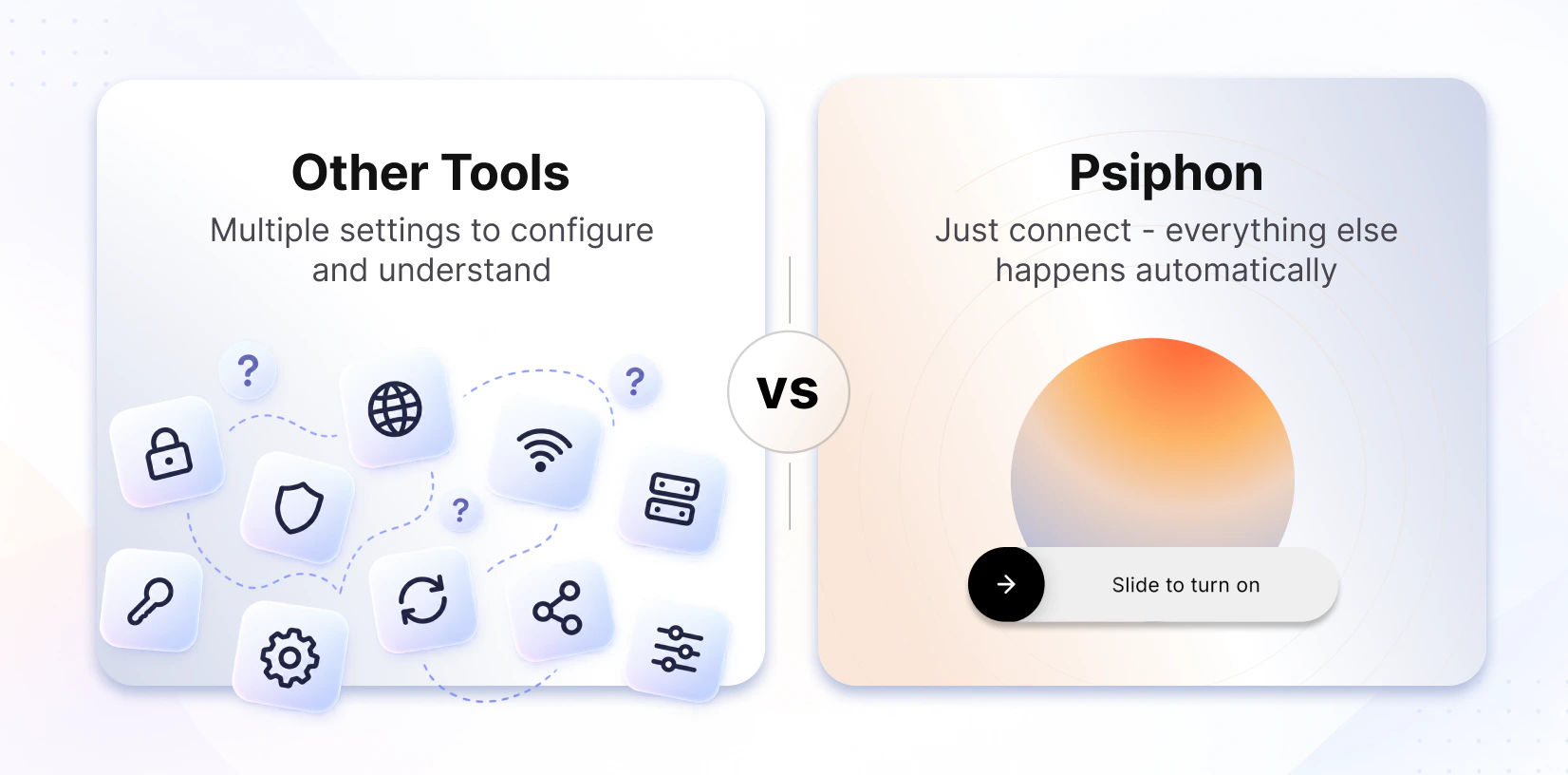
Censorship resistance should not depend on the user knowing what has been blocked. Psiphon handles that complexity automatically. When you connect, it tries multiple available methods and uses obfuscation as part of the connection process, without asking you to choose a protocol or enable a special mode.
That matters because network interference rarely explains itself. There is no message saying that a protocol has been recognized or a server address blocked. There is only an app that will not connect. Users should not have to diagnose the problem before the tools designed to address it begin working.
With Psiphon, circumvention is not an extra feature. It is built into the connection from the start.
SECTION 3
The network
Over 50,000 servers across 33 countries.
A network that keeps changing
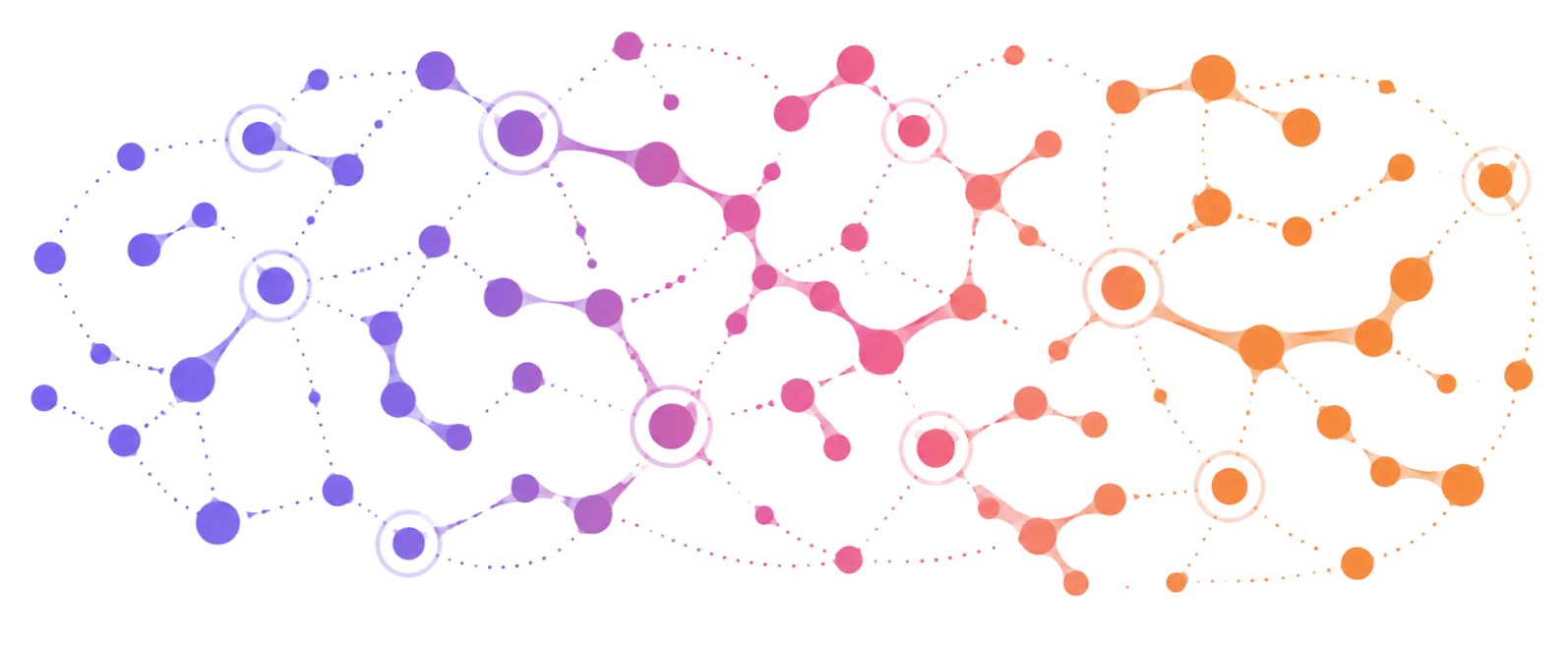
Psiphon does not rely on a fixed list of server addresses. New servers are added, and routes that become blocked or stop working can be replaced. Blocking one address may close one path, but others can remain available.
The network is designed not simply to be large, but to adapt as blocking changes.
High speed for all your needs
Psiphon is designed for more than basic browsing. It supports bandwidth-intensive activities such as HD streaming, video calls, and large downloads across supported devices.
Capacity distributed across many locations helps reduce congestion and gives Psiphon more viable routes to choose from. Resilience comes from the network's ability to adapt; capacity helps keep those connections useful once they are established.
A subscription gives you unlimited access with all features available, on servers provisioned for high-throughput traffic.
Conduit: access powered by people
Conduit lets people share spare capacity from their own devices and internet connections so that others can reach the open internet through Psiphon. These stations add capacity across many different consumer networks, rather than concentrating every connection in a small number of data centres and hosting ranges.
That diversity gives Psiphon more possible paths when conventional server addresses are blocked. It also makes Conduit a two-way exchange: by running a station and helping someone else connect, you can use Psiphon without paying for a subscription.
On Android, you can start Conduit directly from the Psiphon app. You remain in control of when it runs and can stop it at any time.
Learn more at conduit.psiphon.ca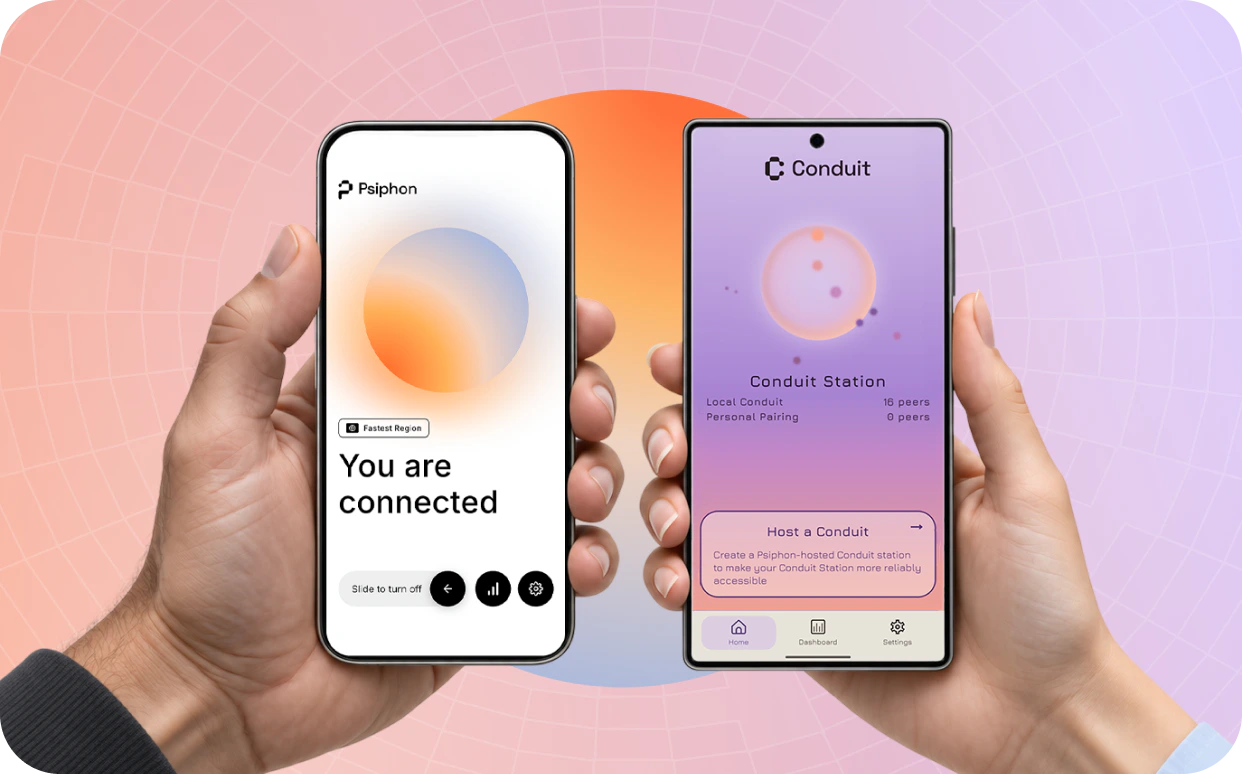
SECTION 4
Features
One app, one button, everything behind it.
Connects automatically.
Tap or click Connect and Psiphon tries the available routes and connection methods for you. If a connection stops working, Psiphon keeps trying and can reconnect another way. You do not need to choose a protocol or turn on a special censorship-resistance mode.
Choose your region.
Psiphon picks the best available route by default. If you would rather appear somewhere specific, you can select a region yourself, and a subscription opens up the full list.
Split tunnelling.
Choose which apps use Psiphon and which stay on your normal connection. Only on Android and Windows (Legacy).
No account required.
Install and connect without creating a Psiphon account or giving Psiphon an email address. Purchases made through Google Play or the App Store are billed through the store rather than through a Psiphon account.
Getting the most out of it
Step-by-step guidance for every platform lives in the Help Hub, including installing when the app store or our site is blocked, choosing a region, split tunnelling, and what to do when a connection will not establish.
Go to the Help HubSECTION 5
Free for everyone
Psiphon is free to use anywhere in the world, and especially in heavily censored regions where payment restrictions make subscribing more difficult. Keeping access open for the people who need it most is core to Psiphon's mission.
To learn more about the different ways to access Psiphon, visit the Help Hub →
SECTION 6
What you can check
We do not know who you are.
You can install Psiphon and connect without an account, an email address, or a payment method. There is nothing to collect, because we never ask.
We are open source, and audited.
The code for Psiphon's clients and core tunnelling technology is public, so researchers and developers can inspect how it works. Independent security firms, including Cure53, have reviewed specific Psiphon components, and we publish their reports.
Our network data is public.
We publish live, aggregate statistics showing the scale of the Psiphon and Conduit networks, including monthly and daily users, data transferred, and Conduit station activity. Each figure links to its source and shows when it was last updated.
We cannot provide information we do not have.
We have received legal requests seeking identifying information about individual Psiphon users. We did not have the information requested and therefore could not provide it.
What Psiphon is not built for
Psiphon is a circumvention tool, not an anonymity network. It encrypts traffic carried through the Psiphon tunnel and is designed to help you get around blocking on the network you are using. Like other VPNs, It does not make you untraceable to an observer able to monitor traffic at multiple points across the internet. Protecting against that kind of traffic correlation requires a different architecture and threat model.
Psiphon also needs a route to the wider internet. When at least one route remains available, it can try different connection methods and keep retrying as conditions change. If a network is completely disconnected from the global internet, no conventional VPN can create a connection on its own. Psiphon is researching and testing ways to extend access through alternative links and local relays, but that work is ongoing.
For a precise account of the data Psiphon processes, what it can see, and how long information is retained, see Policies & Data Handling.
Twenty years of staying online.
Psiphon started as a research project at the Citizen Lab at the University of Toronto, asking how ordinary people could help each other get around censorship. It has been running continuously ever since, through elections, protests, and national shutdowns.
Read about our mission and where we came from →